
There is a particular kind of silence that arrives after a night feed.
The baby is finally settled. The light is low. A half-finished drink is still on the bedside table. You stand up slowly, place one hand over your middle and wait for the rest of your body to follow.
Nothing is dramatically wrong. But nothing feels quite familiar either.
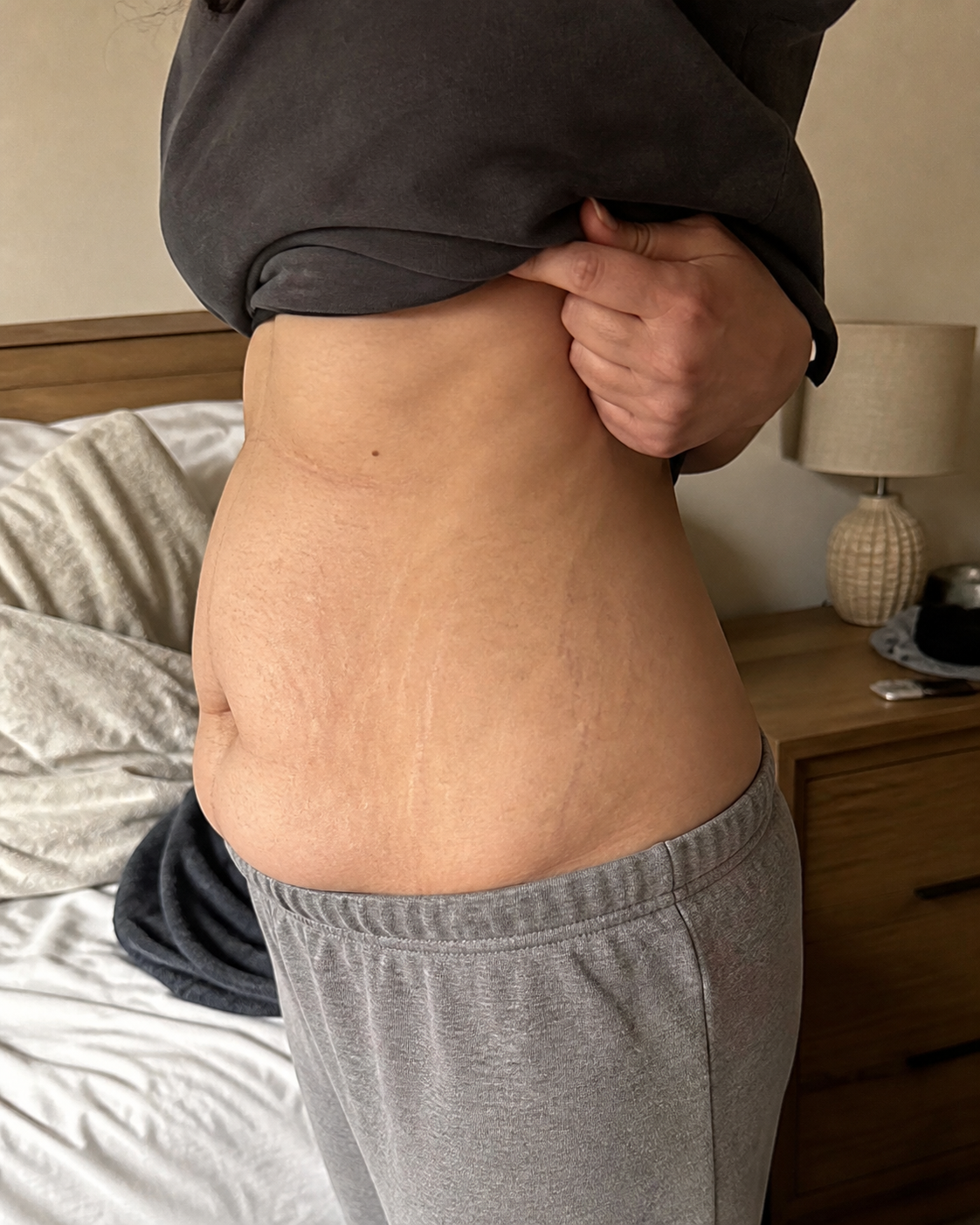
Your middle can feel softer, heavier or less organised than it did before pregnancy. A waistband lands differently. Getting up from the floor takes more thought. A fitted top that technically still fits somehow does not hang the same way.
You are not asking to erase pregnancy. You are not trying to become a “before” photograph. You would simply like to feel a little more held while you move through the day.
So you try support.
You fasten a broad band around your waist. Standing in front of the mirror, the pressure feels reassuring. For five quiet minutes, your middle feels contained and you think, Maybe this is what I was missing.
Then real life starts again.
You sit to feed and the edge presses into a different place. You bend over the cot and the panel shifts. You pull on trousers and the outline shows. You loosen the band, then wonder whether it is doing anything. By lunchtime, it is folded beside the bed or pushed into the changing bag.
The disappointment feels strangely personal.
The support worked while you stood still. The problem was that your life did not.
When “try harder” becomes the only advice you hear
Perhaps you respond by trying harder.
You save postpartum workouts. You start walking again. You pay closer attention to meals. You test breathing exercises, gentle core work or the press-ups and strength routines you enjoyed before pregnancy—when your care professional says you are ready.
Exercise can be a valuable part of postpartum health. It can support strength, energy and confidence. But exercise is not underwear, and it cannot provide the immediate externally held feeling some women want while feeding, dressing, walking or carrying the changing bag.
Those are different jobs.
The problem begins when every postpartum concern is treated as evidence that you lack discipline.
If your stomach still looks rounder than expected, try harder. If your waistband feels wrong, try harder. If a wrap is too uncomfortable to keep wearing, apparently you should tolerate it better.
But what if effort is not the missing piece?
What if you have been asking one tool to do the job of another—and accepting support products designed for a body that never sits down?
The mirror cannot tell you what changed—or what kind of help you need
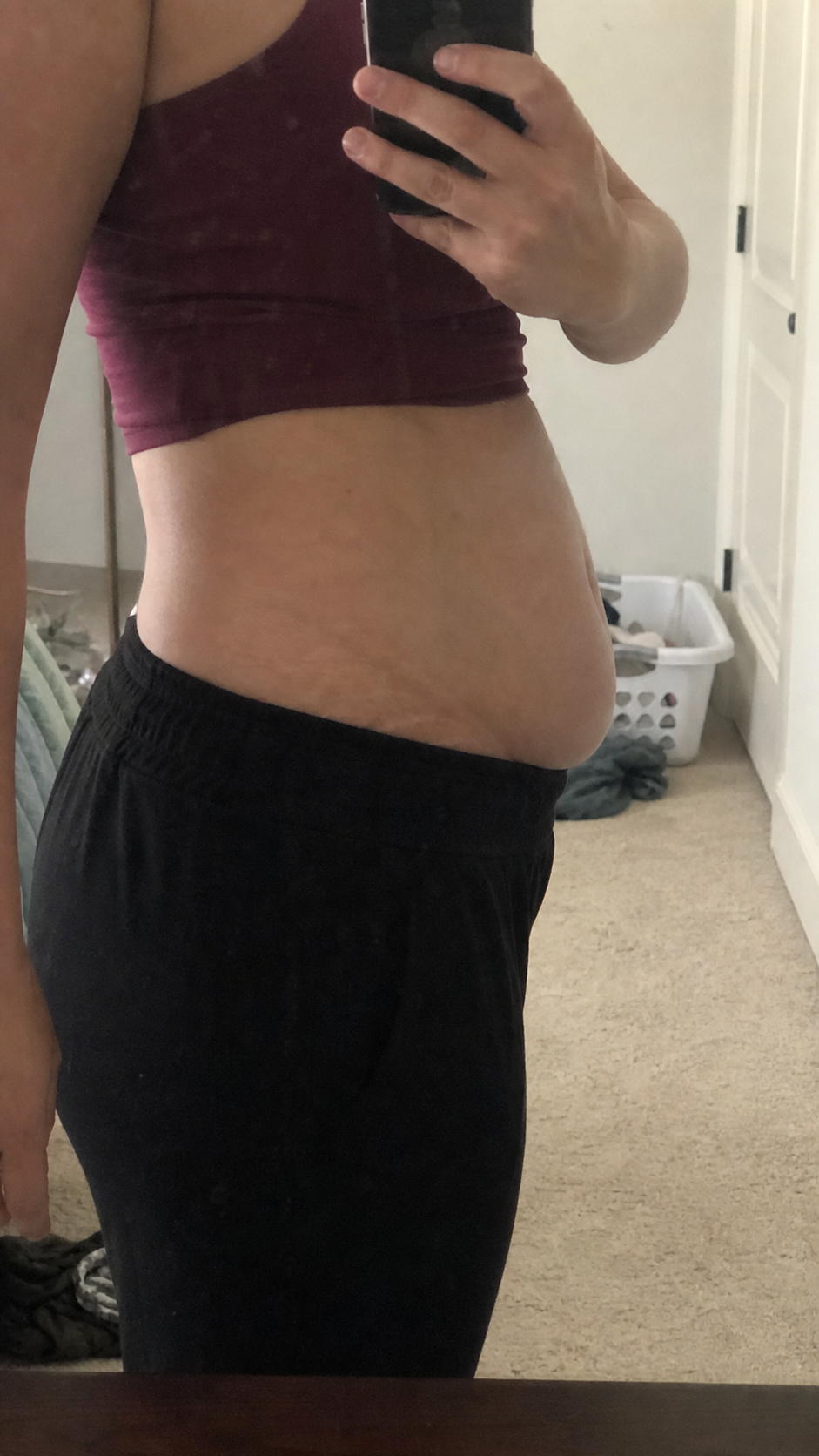
Pregnancy asks the abdominal wall, skin, connective tissue, posture and pelvic floor to adapt over many months. After birth, those tissues do not all return to a previous state on the same schedule.
That does not mean every visible postpartum belly is diastasis recti. It does not mean shape alone can diagnose anything. It certainly does not mean a garment can heal tissue or replace assessment by a qualified professional.
It means the view in the mirror is only the surface of a much more individual recovery.
Some women notice abdominal separation. Some notice tenderness, weakness, bloating, altered posture, scar sensitivity or simply a different distribution of skin and tissue. Many notice several things at once.
That is why broad internet promises are so unhelpful: “flatten your belly”, “close the gap”, “get your body back”. They collapse a complicated experience into one cosmetic instruction.
Can a support garment provide a smoothly held feeling during ordinary movement without claiming to treat the body underneath it?
Your day is the real fitting room
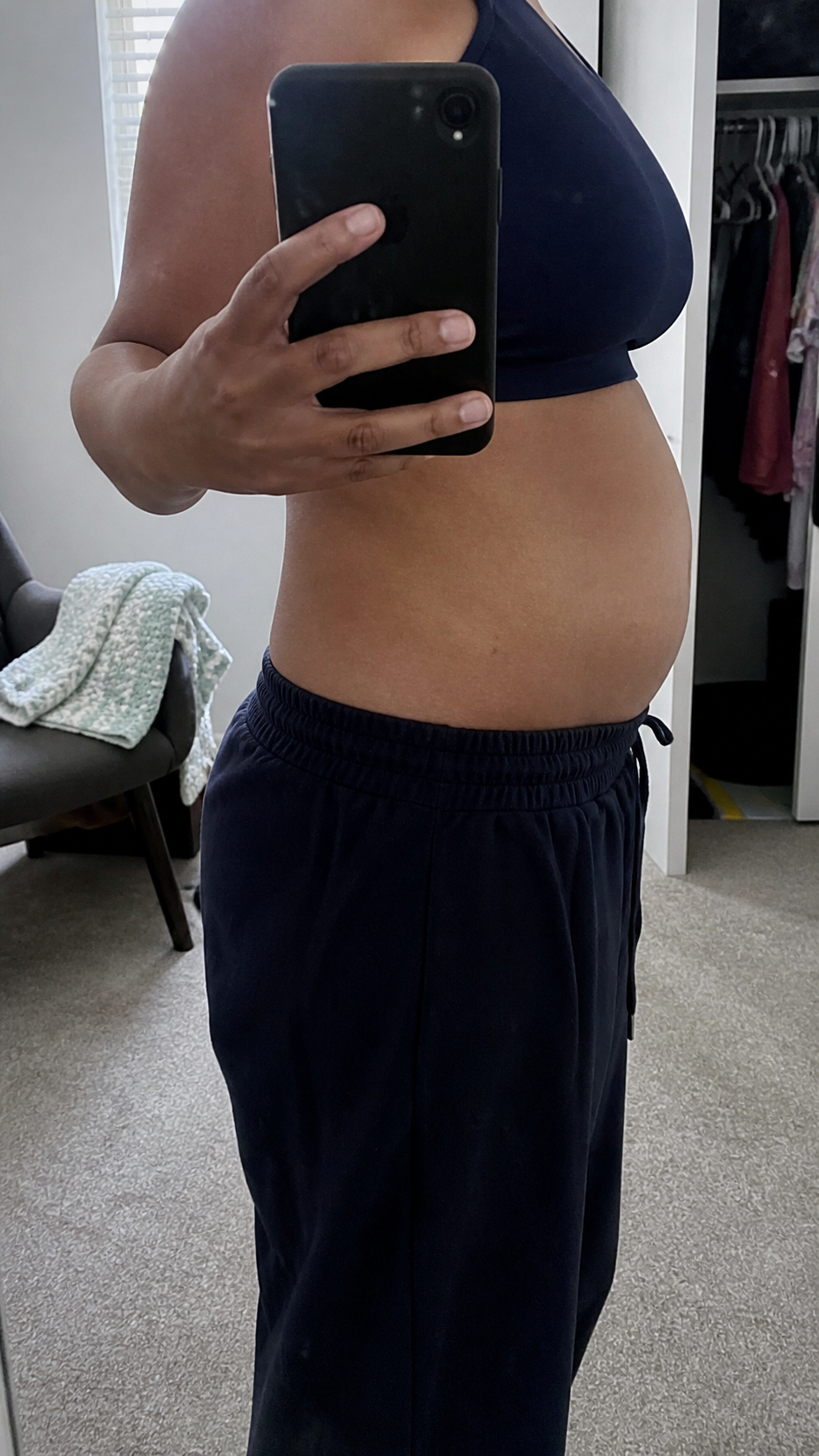
An external wrap can feel impressive during a thirty-second fitting because standing lengthens the torso and gives a broad panel room to sit flat.
But the postpartum day is made of position changes.
You sit on the edge of the bed. You sink into the sofa. You lean over the bassinet. You twist towards the back seat. You kneel to dress an older child. You carry laundry against one hip. You feed, burp, walk, reach and repeat.
Each movement changes the distance between the ribs and hips. The abdomen softens, folds, lengthens and shifts. A separate rigid layer has to negotiate every one of those changes.
The band may roll because its edge meets a fold. It may ride because the torso shortens. It may show because it sits over underwear as another layer. It may feel secure at the front yet disconnected from the sides and back. It may need to be loosened for sitting and rebuilt for standing.
None of this proves the wearer failed. It may mean the format was designed around compression first and daily wear second.
The problem with treating “more pressure” as the whole answer
Most wraps rely on a simple logic: place a wide panel around the middle and tighten it until the wearer feels compressed.
Pressure is not inherently bad. Compression garments are supposed to compress. But pressure has direction, placement and context.
A single broad panel tends to create a generalized squeeze. Increase the tension and the squeeze becomes stronger, but the arrangement remains the same. It is still one layer pressing around a moving, curved body.
That is why stronger does not automatically mean more wearable.
If the garment demands constant adjustment, the practical dose of support is not the pressure it can produce in a photograph. It is the amount of time a real person is comfortable keeping it on.
The support left in a drawer cannot become part of a routine.
How can support travel across the body—and remain easy enough to wear that it stays present through the day?
The older wrapping idea that inspired a different answer
Bengkung wrapping traditions use long fabric bands arranged around the torso in overlapping, directional passes.
NurtureForm did not try to reproduce a traditional wrapping ritual or claim that tradition itself guarantees a result.
Instead, the design focused on one useful structural idea: crossed support does not have to travel in only one horizontal line.
What if diagonal pathways could be integrated into a garment that already belongs in the daily wardrobe? What if the crossed structure were present the moment the wearer pulled it on?
That line of thinking became Bengkung-inspired X Matrix Compression.

The mechanism reveal: X Matrix Compression
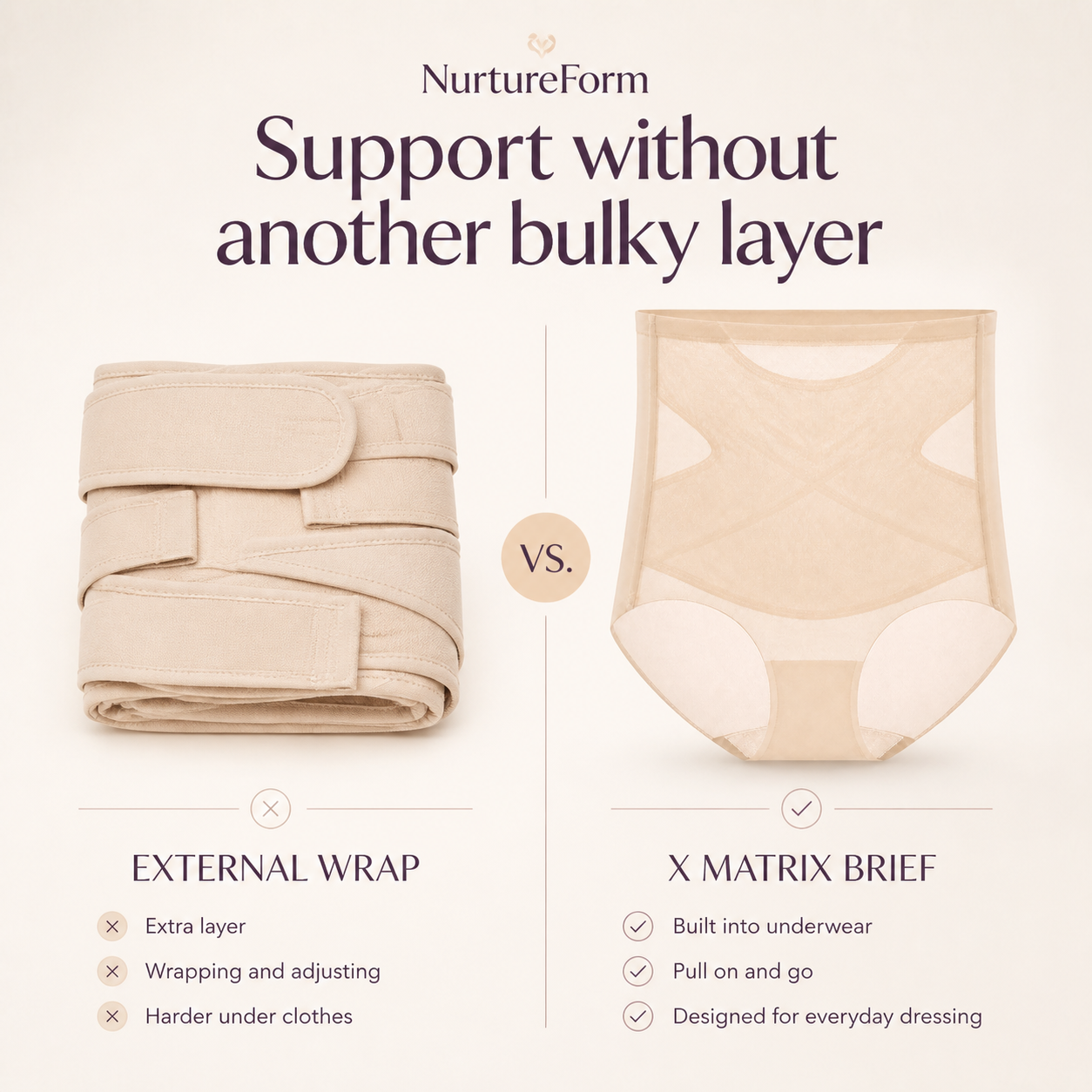
X Matrix Compression uses diagonal support pathways that visibly cross through the high-waist section of the brief.
Instead of asking one flat panel to do everything, the construction distributes the supportive feel through an X-shaped arrangement integrated into the underwear itself.
The product remains a compression garment. It does not manipulate muscles into place, close abdominal separation or permanently change anatomy.
Its job is immediate and practical:
- Create a smoothly held feeling across the middle while worn.
- Combine support and underwear in one pull-on layer.
- Remove the separate fastening and wrapping ritual.
- Sit beneath ordinary clothing with less bulk than a traditional external wrap.
- Remain relevant during sitting, feeding, walking and everyday movement.
NurtureForm is not promising to finish postpartum recovery for you. It is trying to make support easier to include in the life you already have.
Why putting the mechanism inside a brief changes the experience
The most obvious difference is not what the brief adds. It is what it removes.
There is no separate band to centre over underwear. No long strip to wind around the torso. No hook-and-loop fastening to catch on other fabric. No recovery layer to remember after getting dressed.
You pull on the brief as underwear. The high waist positions the crossed structure across the middle. Once trousers, leggings or a dress go over it, there is no second support routine waiting to be completed.
This matters because friction is cumulative.
One extra fastening does not sound like much. Neither does one extra adjustment after sitting. But postpartum life already contains dozens of tiny tasks: bottles, feeds, nappies, washing, appointments, medication, water, snacks, sleep calculations and the constant question of what the baby needs next.
A product can fail without being physically broken. It can fail by asking for more attention than the wearer has available.
The X Matrix Brief is designed to ask for less.
“But isn’t this just shapewear with a postpartum label?”
That is a fair question.
Traditional shapewear is often sold around visual transformation: a smaller-looking waist, a smoother outfit or a dramatic before-and-after.
NurtureForm has a different starting point. The X Matrix is built around crossed support architecture, a high-rise postpartum-friendly format and the practical problem of keeping support wearable through ordinary movement.
It may create a smoother, more contained appearance while worn—that is part of what compression garments do. But appearance is not the only design job.
- Can you sit without rebuilding the garment?
- Can you wear it as underwear rather than over underwear?
- Can normal clothing go over it without planning the outfit around a belt?
- Can the support remain present while your attention moves elsewhere?
The goal is not to punish the body into a smaller shape. It is to make a held feeling easier to live with.
A realistic first wear—not a miracle timeline
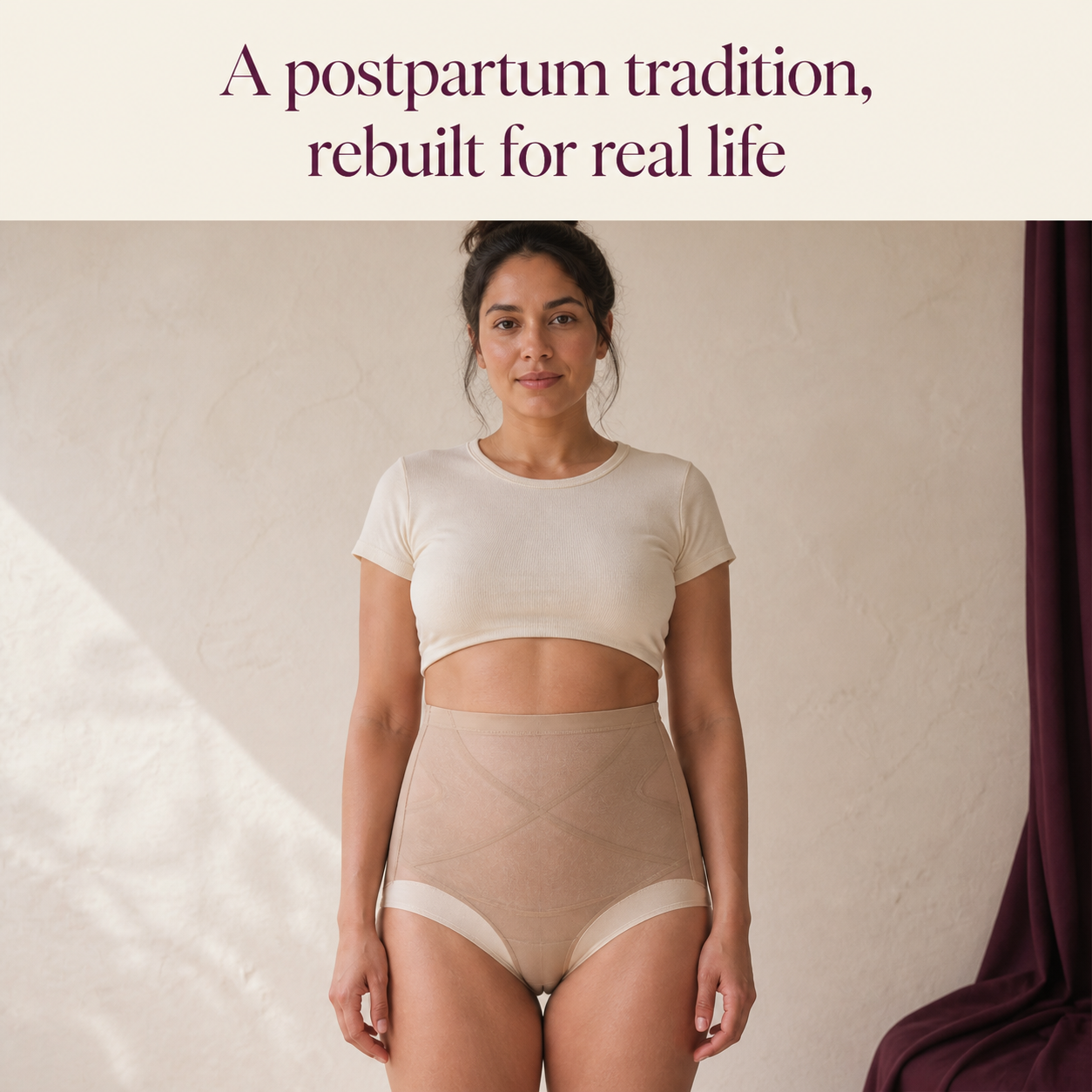
Imagine the first morning you try it.
You step into the brief and pull the high waist into place. The compression feels present—perhaps firmer than usual underwear, but without a separate panel to pull across and fasten.
You look in the mirror. The garment may make the area look smoother while it is on. But nothing underneath has been instantly repaired, and the honest test has barely begun.
Then you sit.
This is the moment a product photograph cannot show. Your torso shortens. Your middle changes shape. You wait for the edge of a band to dig in or for a fastening to announce itself.
There is no external fastening. The brief remains one layer.
You stand again. You do not have to unwrap and rebuild it. You pull on trousers, check the waistband and move towards whatever the morning is already asking from you.
That does not mean every person will love the same compression level or fit. Bodies, sensitivities and preferences differ. It means the design can finally be judged in the environment that matters: a moving day.
What the first day is actually made of
7:10 AM — Getting dressed
The support is integrated into the underwear. One garment replaces the underwear-plus-wrap combination.
8:05 AM — Sitting for a feed
The torso folds and softens. There is no detachable panel to reposition.
9:40 AM — Reaching into the cot or car seat
Diagonal pathways remain part of the brief as you bend and rotate. The product provides external compression, not strength or treatment.
11:30 AM — Walking outside
The brief sits beneath ordinary clothing. You are not carrying a separate wrap or deciding whether to put it back on.
1:15 PM — The sofa test
The X Matrix format keeps the support inside the underwear layer rather than adding recovery equipment on top.
4:20 PM — Your attention is somewhere else
The strongest sign of wearability may be that you have stopped monitoring the garment every few minutes.
Evening — The honest assessment
Not “Did my body permanently change?” but “Did I feel comfortably supported often enough to want to wear this again?”
What changes when the support follows the day

Maybe the day includes ten quiet minutes on the sofa before the next feed.
Maybe it includes school drop-off with an older child, a grocery run, a stroller walk or laundry that has been waiting for three days.
Maybe it is the first time you put on a fitted outfit and do not want a separate band visible beneath it.
Maybe you spend most of the day at home and still want the reassurance of a held feeling when you stand, bend or carry.
The X Matrix Brief does not need the day to look aspirational. It is designed for repetition.
Pull it on. Get dressed. Sit down. Stand up. Move on.
That sounds almost too ordinary to be an innovation. But ordinary is exactly where postpartum products are tested.
Five objections worth answering before you buy
“Will it flatten my stomach permanently?”
No compression brief should promise that. NurtureForm can create a smoother, more supported appearance while worn, but it does not permanently reshape the body.
“Will it help if I have diastasis recti?”
The brief provides external compression but is not a diagnostic or therapeutic device. Assessment and rehabilitation advice should come from a qualified healthcare professional or pelvic-health physiotherapist.
“Can I wear it after a C-section?”
Timing and comfort after surgery are individual. Do not place firm compression over a healing or sensitive area without guidance. Ask your maternity or surgical care professional when it is appropriate.
“Will it roll or feel firm?”
Experience depends on torso length, sizing, movement and sensitivity. The integrated brief removes a separate wrap edge and fastening, but correct sizing still matters. The 60-day promise allows real-life assessment.
“Do I need to stop exercising?”
No. NurtureForm is not an alternative to appropriate movement, rehabilitation or medical advice. The brief and exercise have different jobs.
What NurtureForm does—and deliberately does not—promise
What is locked into the product
- Bengkung-inspired X Matrix pathways
- Ultra-thin high-waist brief
- Pull-on format with no separate wrap
- Sand and Black available
- 60-day comfort promise
What is not promised
- Medical diagnosis
- Closure of diastasis recti
- Healing after surgery
- Guaranteed measurement loss
- Permanent anatomical change
This is not weaker marketing. It is a clearer reason to buy: you know what the garment is designed to do, when it does it and what you are assessing during the promise period.
Who the X Matrix Brief may be right for
It may suit you if you want a held feeling during ordinary movement, dislike separate wraps and fastenings, prefer support integrated into underwear and want an alternative to “snap back” messaging.
It may not suit you if you dislike compression, firm clothing irritates a sensitive or healing area, you need treatment for pain or a complication, a professional has advised against compression, or you expect permanent change after removing the garment.
Choose the routine that fits your week
Sand and Black available. Rose and Ice Blue are sold out.
Try the X Matrix format in your preferred available colour.
Three briefs for a wear, wash and ready rotation.
Five briefs for a fuller weekly rotation.
Time to assess fit and comfort in your actual routine—not a recovery deadline or guarantee of physical change.
Before you buy another postpartum wrap, ask a better question
Do not ask only: How tight is it?
Ask where the support travels. Ask what happens when you sit. Ask whether it adds another layer over underwear. Ask whether it needs to be fastened and adjusted. Ask whether you can judge it by comfort and wearability rather than a transformation promise.
The strongest support on paper is not necessarily the support that becomes part of your life.
The support you can actually wear has a chance to be present when the day changes shape.
No separate band. No wrapping ritual. No demand to fight your body.
Just Bengkung-inspired X Matrix Compression integrated into an ultra-thin high-waist brief—and 60 days to decide whether the format feels right for you.